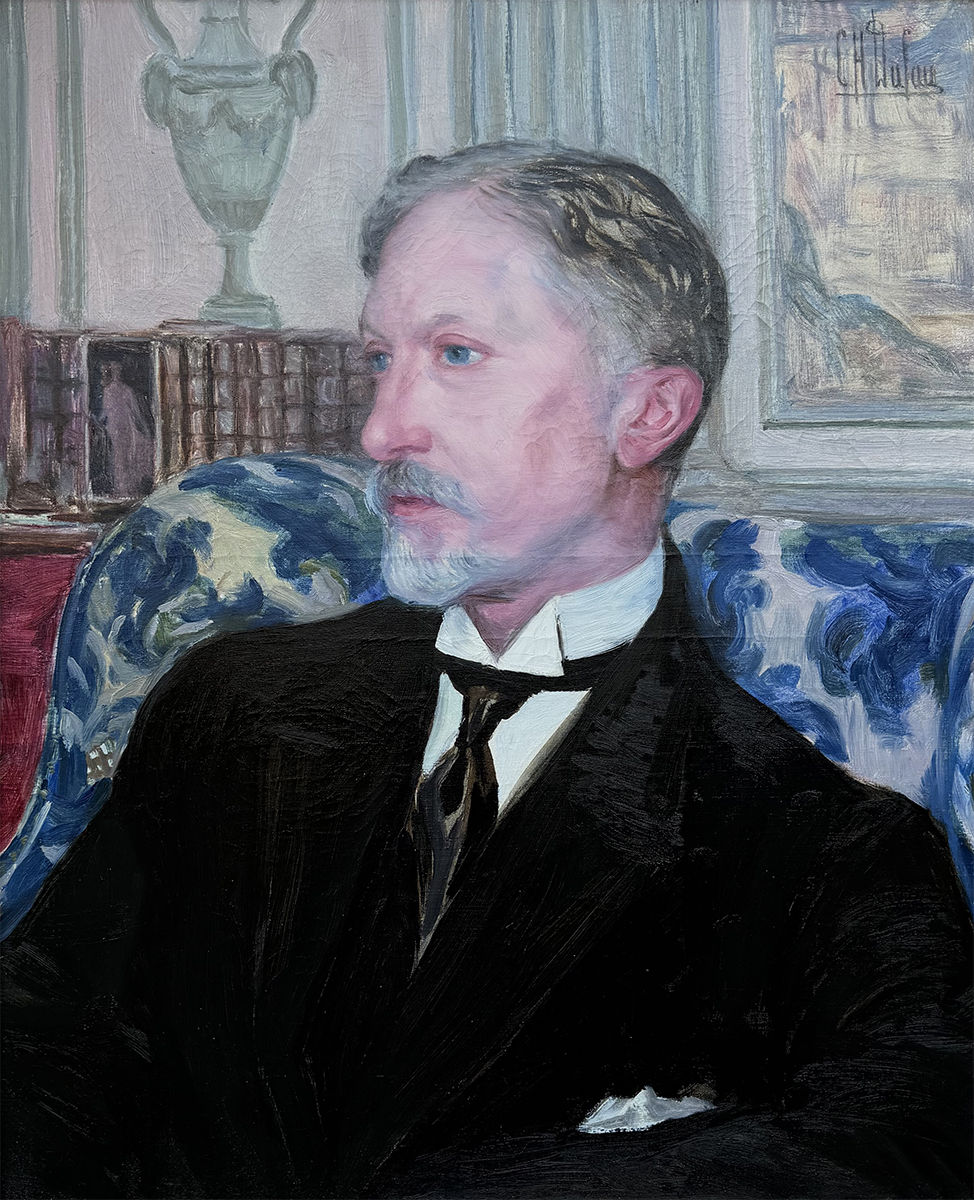


Clémentine Hélène Dufau French, 1869-1937
Framed size: 70 cm x 60 cm
Signed


Literature
Clémentine Hélène Dufau was born in 1869 in Quinsac in the Gironde region of France, near Bordeaux. Her father was an entrepreneur of Basque ancestry, and having made a fortune in Cuba, married the daughter of the owner of Le Chateau de Clauzel vineyard. The vineyard is still producing classic Bordeaux wines today.
She suffered ill health as a child and spent much of her enforced bed rest drawing. By the age of nineteen she expressed a wish to study in Paris, and with the help of her parents was able to enrol at the Academie Julian. Her tutors there were the academic artists Wiliam Bougereau and Tony Robert-Fleury.
In 1875 she exhibited at the Le Salon des Artistes Français and was awarded the Marie Bashkirtseff prize for her painting L'amour de l'art. This early success led to commissions for various posters, including one to announce the launching of the magazine La Fronde, founded by Marguerite Durand in 1897.
In 1898 Clémentine Hélène Dufau became a member of the Société des Artistes Français, and spent a year in Spain on a scholarship, exhibiting the resulting paintings to great acclaim on her return to Paris.
The highly successful playwright Edmond Rostand saw her painting L'automne at the Salon des Artistes Français in 1902 which he greatly admired. This led him to commission her to paint a second version on a panel to fit the library of his newly built Villa Arnaga in Cambo-les-Bains. The resulting painting was such a success that she spent several periods between 1906 - 1912 producing many paintings to decorate the villa. These included symbolist subjects for various rooms, and multiple portraits of Edmond Rostand, his wife Rosemonde, and his son Maurice, with whom she fell in love. This proved to be a tortured and unsuccessful relationship.
In 1909 Clémentine Hélène Dufau was made a Chevalier de la Légion d'honneur. Following this recognition of her contribution to art, the French government commissioned her to paint four panels for the Sorbone's Salle des autorites, depicting Astronomy, Mathematics, Radioactivity and Magnetism.
Also, in 1909 she exhibited in the International Art Exhibition in the Glastpalast (Glass Palace), Munich, and the exhibition The Art of Women (Die Kunst der Frau) held in the Vienna Secession Building between November 1910 and January 1911. This was organised by the Austrian Association of Women Artists, an international survey of female artists, and is considered the first feminist exhibition of its kind.
As an established artist in Paris, she received many commissions for portraits from fashionable and wealthy personalities. These included the couturier Jeanne Lanvin, fashion illustrator George Barbier, and poet, author and socialite Comtesse Anna de Noailles, amongst others.
The First World War saw her creating propaganda on behalf of the French State.
She moved to Antibes in 1926, to a studio directly overlooking the sea, where she painted many scenes of bathers, in a response to a return to peace and the new atmosphere of the 1920's.
On her return to Paris, Clémentine Hélène Dufau was a founding member of the Société des Femmes Artistes Modernes (FAM) in 1930. The Society exhibited in group shows until 1938. Their exhibitions were held in various venues such as le Petit Palais, Galerie de la Maison de France, Galerie Bernheim-Jeune. The large membership included Tamara de Lempicka, Marie Laurencin, Suzanne Valadon, Marie Mela Muter and Marthe Lebasque. She also completed a book in 1931 Les trois couleurs de la lumière. This work contains unifying thoughts of an esoteric and scientific nature and alludes to her increasing feminist ideals. A copy of the book is held in the Musée Carnavalet in Paris.
Clémentine Hélène Dufau died in Paris in 1937.
Her work shows the influence of Art Nouveau and the painters of the Austrian Secession, particularly Gustav Klimt and Egon Schiele, embracing Symbolism and Expressionism.
Museums:
- Musée d'Orsay
- Musée des Beaux-Arts de Reims
- Villa Arnaga, Cambo les Bains
- Musée d'Art et d'Histoire de Cognac
Join our mailing list
* denotes required fields
We will process the personal data you have supplied in accordance with our privacy policy (available on request). You can unsubscribe or change your preferences at any time by clicking the link in our emails.